
Fish hearing
Fish don’t have ears, right? Wrong! They do, just not on the outside of their heads like we and most other animals have. In fact, ears are just as important to a fish as any other creature and, compared to those of mammals, are often incredibly advanced…
Issue 16 (May-Jun 2017) Bill Brazier


Whilst some fish may lack colouration, certain fins, teeth, lateral lines or even eyes, all fish – that’s over 30,000 species – have ears. They are something no fish can live without. Sound travels over four times faster in water than it does in air, and reverberates for much greater distances too. So, as you might imagine, hearing is vitally important to a fish. The detection of predators, for example, may often rely (at least partly) on hearing. A sense of hearing also tells fish a great deal about the environment around them, their relative position and even where their food is. This ‘3D’ view, unlike other senses, is not hindered by light levels, currents, or even the presence of most objects in their environment.
A fish’s ears are actually very similar to all other vertebrate animals, including us humans, except that they are located internally in the head instead of externally. The reason for this is due to the fact that the body of a fish is, for all intents and purposes, the same density as water and sound actually travels through them. As such, they do not need outer ears like us and most terrestrial animals to channel sound into the inner ear.
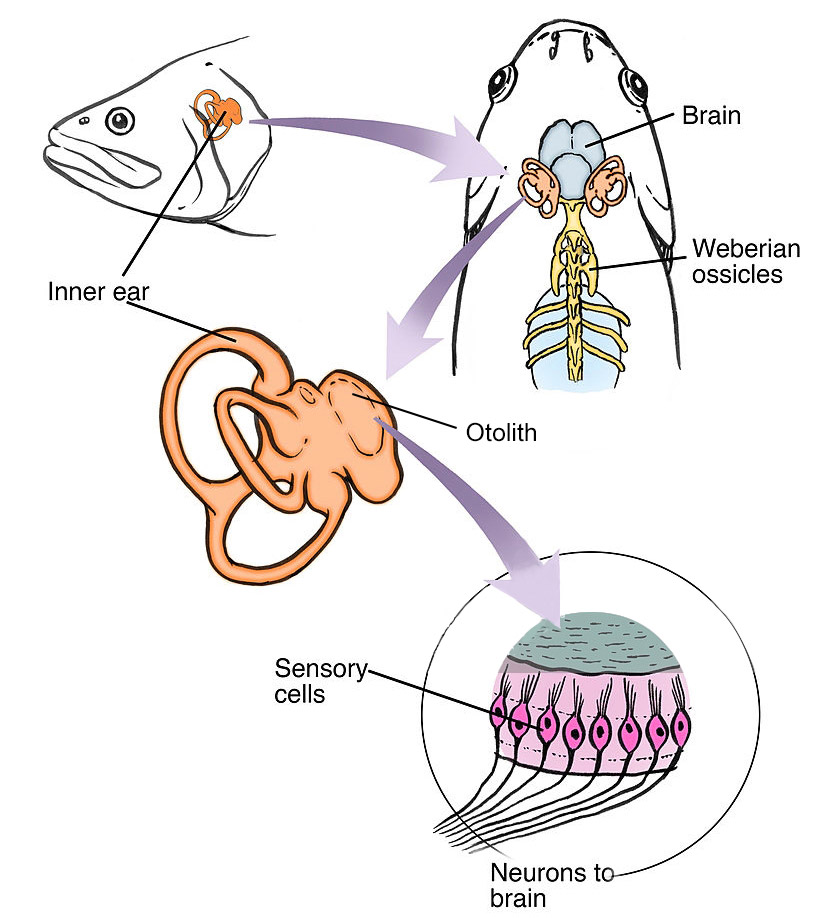
Fish have bones in the inner ear, called otoliths, which are much denser than water and the fish’s body (in humans, otoliths are known as ‘ear stones’ and are required for balance). As a result, these ear bones (of which there can be 1-3) move more slowly in response to sound waves than the rest of the fish. The difference between the motion of the fish’s body and the otoliths bend tiny sensory hairs in the inner ear, called cilia. These are essentially the same type of sensory cells (neuromasts) that are located in the fish’s lateral line as explained way back in issue 6 – available here . This small movement between the ear bones and sensory cells is transmitted to the brain and translated into sound.
How fish are aged from otoliths
Otoliths are made of calcium carbonate and their size and shape is highly variable among fish species. In fact, scientists can tell each most species apart just from its ear bones. Otoliths are routinely used for aging fish. Similar to the rings of a tree and, otoliths feature a clear pattern of growth over the lifetime of a fish. Otoliths grow along with the rest of the fish and show both periods of low growth (winter) and high growth (spring to autumn). This pattern results in darker ‘narrow bands’ and lighter ‘wide bands’. Narrow bands, called checks, are counted as one winter’s worth of growth. A narrow and a wide band together represent one year’s growth and collectively are termed ‘annuli’ and are counted to estimate the total age of the fish. Sometimes otoliths are clear enough to see the growth pattern under a microscope as is, but they often have to be thinly sliced with lasers to obtain a clear enough sample. Otoliths are typically more accurate for aging fish than scales although, of course, unlike scales, they require the fish to be dead which isn’t always preferable in scientific studies.

So, all fish hear sound due to vibrations in the inner ear but the basic ear is fairly limited in its range of use. Fish are broadly classified as being either “hearing generalists” (relatively limited range of frequencies which they can detect) or “hearing specialists” (wide range of frequencies). Fish without swim bladders (primarily used for buoyancy) , such as sharks and rays (elasmobranchs), or with just a small one such as most flatfish, have a poor hearing capacity. Salmon and eels also have poor hearing. Most fish species though do have swim bladders, which are in turn connected to the inner ear. Swim bladders act as a secondary source of sound for fish, acting as a sort of drum to detect a greater range of sounds and frequencies. The closer the distance between the swim bladder and the inner ear, the better a fish’s hearing is. Hearing generalist species have a narrower hearing frequency range (less than 1500Hz) and higher hearing threshold (above 100dB) than hearing specialist fish (up to 8kHz and down to 60dB).
“Fish are broadly classified as being either “hearing generalists” (relatively limited range of frequencies which they can detect) or “hearing specialists” (wide range of frequencies)”
Whilst fish are usually able to hear sounds of a far lower frequency than mammals (down to 0.1Hz), most are unable to detect sounds above 1kHz. However, some species have developed an advanced mechanical link between the swim bladder and inner ear which gives them a fishy sense of super-hearing. These species are known as otophysan fish and include the majority of freshwater fish worldwide, such as the minnow, catfish and carp families. This mechanical link consists of a series of modified backbone vertebrae called the Weberian ossicles. This system conveys sounds and changes in pressure and greatly improves hearing transmission and sensitivity. The Weberian ossicles act as an amplifier of sound waves that would otherwise be only slightly detectable by the inner ear structure alone.
As mentioned above, elasmobranchs (the sharks and rays) have a relatively poor hearing range but what they lack in sound detection they certainly make up for in other ways, such as their highly advanced lateral line and electro-sensory cell systems. Having said this, they are actually well adapted to hear low frequency sounds and possess good directional hearing, but their overall hearing range is narrow. Atlantic salmon also have very poor hearing but possess an acute sense of sight and ability to migrate accurately. Goldfish and common carp have among the best, most sensitive hearing in the fish world, able to detect sounds of up to 4kHz and with an optimum range of 500-800Hz. The old advice of carp anglers needing to be stealthy and quiet certainly rings true here.
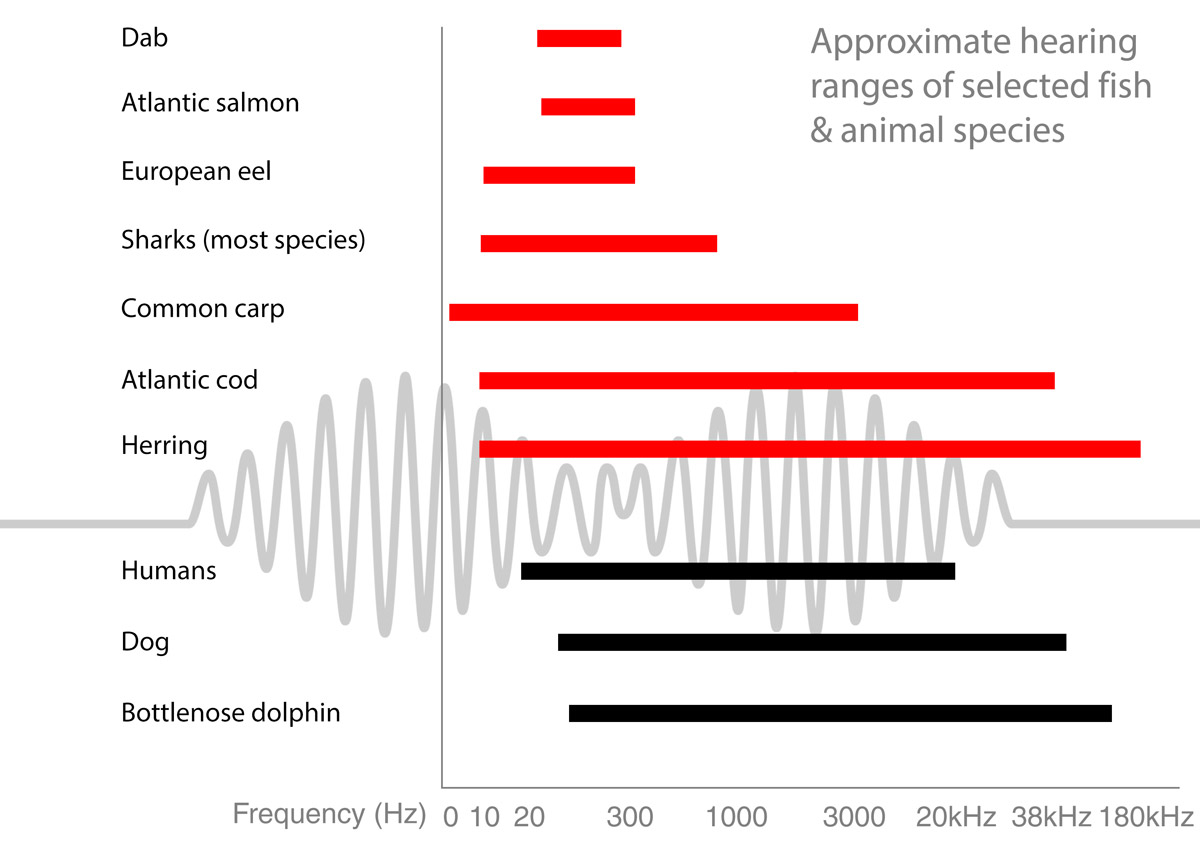
Incredibly, recent research has discovered that some species, such as cod, herring and American shad, can hear in ultrasound (ultra-high frequencies). The reason for this is so they can detect the ultrasonic echolocation “clicks” produced by hunting dolphins, from up to an impressive 187m away. That’s quite an incredible adaption, I’m sure you’ll agree.
Fish also communicate through sound. For example, the gadoids (cod, haddock, pollock etc.) develop muscles in the spring that beat drum-like on the swim bladder, creating a very low-pitch sound that is used during mating. Herring and sprat have a canal from the swim bladder to the anal opening where air can be released, generating a more high-pitched sound. It has been speculated that these sounds are used for some kind of communication between the herring within a shoal.
Some fish are capable of making very loud sounds. One of the noisiest fish in the oceans is the oyster toadfish, Opsanus tau. Because of their noisiness Oyster toadfishes were actually studied by the US Navy because they kept hearing them on their sonar! Studies suggest that the volume of sounds produced by the oyster toadfish can reach 100 decibels (dB), which is equivalent to a piece of heavy machinery.
Despite the similarity of their ears to our own, fish cannot go deaf! Whilst extremely high intensity sounds are able to temporarily damage the cells in the inner ears, they are able to repair and replace damage sensory hair cells throughout their life, unlike humans who are born with a full set which deteriorates with age. In total contrast, fish produce more sensory hairs as they grow and age and several studies have suggested that perhaps older fish are better able to hear than their younger counterparts. However, certain species may be negatively impacted by persistent human made sounds such as those from ships and offshore wind farms.
“Despite the similarity of their ears to our own, fish cannot go deaf!”
Interestingly, farmed fish have worse hearing than wild ones, pretty much regardless of species. This has been repeatedly measured as being up to 50% worse, and is presumed to be largely down to diet in fish farm conditions. Unnatural diets (pelleted food laced with antibiotics and other chemicals) would appear to be responsible for a key deformity in otolith (ear bones) composition, with farmed fish otoliths being composed of a lighter and more brittle form of calcium carbonate. This means they are less able to detect sounds. This could explain the findings of some recent studies, such as farmed salmon showing decreased predator evasion and increased mortality compared to wild fish. This poorer hearing (in what is already a species with poor hearing) may even be linked to a reduced ability to migrate back to spawning sites. Overall, farmed salmon have been found to be ten times more likely to have the otolith deformity than wild fish, and it gets worse with age.
So, hearing is maybe more important to a fish than you first thought. In truth, a fish’s sense of hearing through its ear is just a small part of the incredible advanced system which includes other sensory adaptions such as the lateral line (which also ‘hears’) and this article has barely scratched the surface. Still, you’ll probably never look at that fish in your hand or landing net the same again…
Bill Brazier