
The spread of roach in Ireland (pt. 2)
In little over half a century, roach have become one of the most widespread and perhaps numerous fish in Irish freshwaters, with significant consequences, both positive and negative. In part 2 of this article, we take a look at exactly why roach are so invasive, how they spread so quickly and what impacts they have had on Irish waters and angling alike.
Issue 26 (Jan-Feb 2019) Bill Brazier


As we learned in part one of this piece (available here, for those that missed it ), with the help of anglers as well as by natural means, roach colonised much of Ireland in less than 30 years, from the early 1960s onwards, to the point where they are now, surely our most numerous freshwater species. Incidentally, this is in direct contrast to the UK, where roach populations have suffered widespread decline in the same period.
A commonly used definition of an invasive species is “a plant, animal, pathogen or other organism that is non-native to an ecosystem and which may cause economic or environmental harm or adversely affect human health”. The word ‘invasive’ is not simply a proxy for non-native, as not all introduced species show true invasive tendencies. Carp in Ireland would be a prime example, where it is highly doubtful that this introduced species would have survived at all without human assisted spread and stockings. Invasives generally possess genetic, ecological and or biological traits that increase their likelihood of surviving and adapting to new environments, and allow them to out-compete and often displace native species through various means. From a scientific standpoint, the humble roach certainly fits these criteria.

What makes roach invasive?
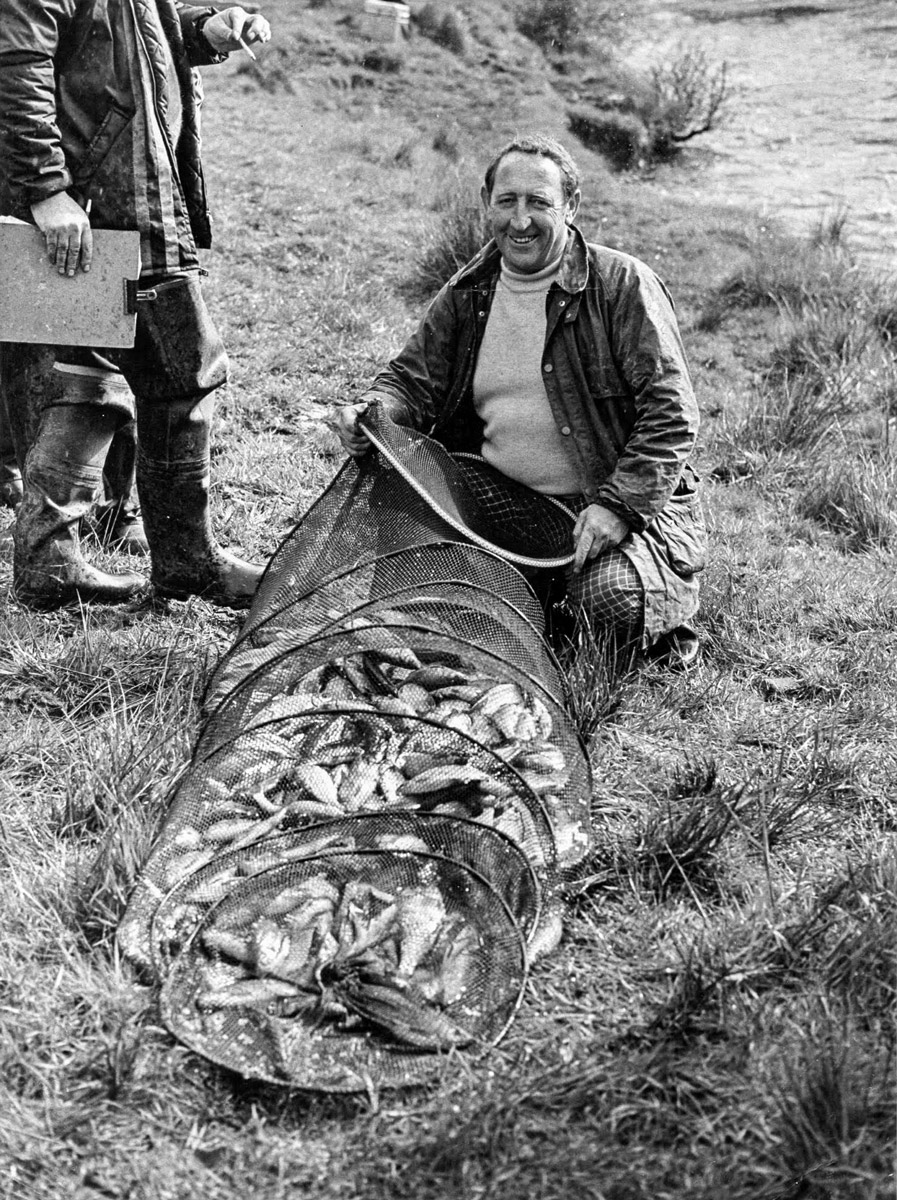
The more technical term for the colonisation of roach across Irish waterways is a biological invasion. A common, if not inevitable, occurrence of such invasions are population explosions, where huge numbers are produced in the early stages of spread, as the species takes advantage of new habitats and resources. Unsurprisingly, some truly huge catches of roach were caught from various venues in the early invasion phase, most notably the Rivers Erne and Bann, which both produced world record weights in the 1970s and early 80s. Pete Burrell’s 5-hour match weight of 259lb 3oz in 1981 from the Sillies River, a small spawning tributary of the River Erne near Enniskillen, Co. Fermanagh, is one of the most famous examples, where he landed three 6oz fish a minute on average. The top five competitors in that event, which included Bill Knot (pictured below) averaged almost 200lb of roach apiece!
“Invasives possess genetic, ecological and or biological traits that increase their likelihood of surviving and adapting to new environments, allowing them to outcompete and often displace native species… the humble roach certainly fits these criteria.”
Population explosions do not always happen, of course, not even with roach, and many early, ‘pioneering’ populations fail due to low numbers (propagule pressure), unsuitable environmental conditions or perhaps extinction via predation. Even where numbers do boom early on, as on the Erne/Sillies, most waters are unable to sustain such large populations for very long (food resources) and densities, usually within a few years, stabilise.
One of the key characteristics which allows roach populations to spread so quickly comes from their highly adaptable nature. Roach are what are known as ‘trophic generalists’, meaning they are able to exploit different food resources and diets, regardless of water productivity, without it affecting their growth. They are equally able to survive on a diet of zooplankton (pelagic, up in the water column) as they are on invertebrates (mostly benthic, on the bottom) meaning competition from other species like bream and tench is never really an issue.
The adaptable food regime and fast growth of roach allows them to reach sexual maturity and spawn very early on in life, typically at 2-4 years old and at <12cm in length (males mature before females). Studies have shown that roach will usually begin spawning at water temperatures of 14-15°C (as with Irish bream, usually in May). As with most members of the carp family (cyprinids), fecundity – the number of eggs produced – is very high in roach, with numbers ranging from 25,000 to 1,000,000 eggs per kg, depending on fish size. While the survival rate of roach fry may not be any higher than other species, early mortalites are offset by the sheer numbers produced.
“One of the key characteristics which allows roach populations to spread so quickly comes from their highly adaptable nature… they are able to exploit different food resources and diets… without it affecting their growth”
Unlike their cousins, bream and rudd, roach can spawn and lay eggs not just on aquatic vegetation but also on stones and other substrates, allowing them to breed successfully where other cyprinids may struggle. They also demonstrate homing behaviour, returning to traditional spawning grounds annually and, as many anglers will have experienced, often travel up rivers to spawn. In fact, research suggests that roach seem to favour overhanging willow roots for laying their eggs on which may partly explain their river migrations even when connected lakes have suitable spawning areas (overhanging willows frequently grow along riverbanks).

What are their impacts?
Given the above characteristics, it should be clear to see how roach spread so far and so quickly in Ireland. Although rarely spoken about in angling circles, roach have had some major impacts on Irish waters. Most notably is their effect on rudd populations, which decline quickly in almost any water where roach appear, sometimes becoming almost extinct, locally. This is simply due to the fact that roach are competitively superior to rudd, as both juveniles and adults. In open-water habitats roach are more efficient feeders. Roach are faster swimmers when feeding, eat a wider range of prey, grow faster and spawn earlier in the year. However, rudd, which consume a lot of plant-based material, are better able to withstand roach invasions in more enclosed, weedy environments.
Numerous Irish studies, mostly led by Dr. Brian Hayden , have shown the clear dietary overlap between bream and roach. Again, similar to the situation with rudd, roach grow faster, spawn more prolifically and are generally more adaptable than bream, which are surprisingly slow growing and selective about where they live and feed.
Roach also compete heavily with perch and, in enriched (eutrophic) lakes, are able to exploit niche foods like blue-green algae (cyanobacteria) as a food source, unlike perch. This is one, over-simplified reason why many Irish lakes with deteriorating water quality (e.g. Lough Corrib, Lough Sheelin) have shifted from being perch-dominated to over-run with roach in recent decades.
The introduction of roach has also negatively affected the native pollan (Coregonus autumnalis), a deep-water whitefish, to the point where, in most lakes where the two species clashed, such as Lough Neagh and Lough Erne, populations have severely declined through competition for food or have become extinct altogether. The same can be said of Arctic char (Salvelinus alpinus). Although roach cannot be solely blamed for the decline in either pollan or char – poor water quality is a huge issue for these species – they have certainly contributed significantly to it in many cases.
The relationship between roach and wild brown trout stocks is interesting. Whilst there is no denying that trout stocks across Ireland have suffered due to declining water quality (enrichment) in recent decades, where roach and trout coexist in mesotrophic waters (ones that are not enriched) they appear to exploit different food resources (Massa-Gallucci, 2009). It is only when the lake shifts to being more eutrophic that trout stocks really begin to suffer from roach competition, even though pike predation on trout reduces in the presence of roach (see latest Inland Fisheries Ireland research, here). Furthermore, because of its feeding habits, roach can have a significant impact on water quality through heightening the effects of nutrient enrichment – more bad news for salmonids. Roach have also been documented to impact some water bird populations (e.g. Lough Neagh).
Widespread hybridisation between roach and bream was recorded throughout Ireland in the 1970s and 1980s following the establishment of invasive roach populations. This often-high level of roach-bream hybridisation is rather unique to Irish waters, and is thought to be largely due to our inherently changeable climate and intermittent spawning windows for both species. This is especially so on larger or deeper systems, where suitable breeding temperatures (and sites) may be more irregular. Spawning overlap between the two is common and, as many of you will know, lots of Irish waters are now dominated by roach and the also very adaptable roach x bream hybrids, to the detriment of bream stocks for which our country was once world renowned. Although not as extensive, hybridisation with roach has also contributed to the nationwide decline of pure rudd.

Do roach have any benefits?
Given the above, you’d be forgiven for thinking that roach are all bad but things are rarely that clear-cut in the natural world and roach have also had some benefits to Irish waters, at least in terms of recreational angling. Roach are now the mainstay of the Irish coarse angling product, with the vast majority of match angling events nationwide now heavily reliant on roach catches, particularly in the colder months when more traditional species such as bream and rudd are less inclined to feed. Many locations that were not worthwhile as competition venues pre-roach, now are. Roach angling has long contributed, significantly, to the Irish tourism product with systems such as the Bann, Erne and lower Shannon now internationally recognised as quality roach fisheries (formerly bream-dominated, of course). Locally, more viable, year-round fishing and fishing venues has undoubtedly improved the Irish tackle trade. So, in this sense, roach have had a positive economic benefit.

Given the species’ propensity to overpopulate and dominate many waters, roach have provided many young or new anglers with their first fishing experience, which can only be viewed as positive for angling as a whole. However, the fact remains that roach are an invasive species in Ireland, in every sense. Whilst angling tourism may have seemingly benefited, Irish home-based angling probably hasn’t. Roach are largely responsible for the decline of both bream and (especially) rudd stocks, as well as contributing to the decrease of the very localised Arctic char and legally protected pollan. Roach have encouraged ecosystem-wide changes across entire systems, such as Loughs Erne and Neagh, for example.
This article has barely touched on the wealth of research done on roach to date, and has given only a brief summary of some very complex, complicated issues. It is impossible to estimate the true economic and ecological impact of roach over the past seventy years or so, since their spread began in earnest, but suffice it to say that Ireland would probably be better off without roach. However, it’s too late now – roach are here to stay, and no amount of nostalgia or even fisheries management will return things to how they once were. In that regard, we should ideally focus on keeping the remaining roach-free waters and systems free of roach and prioritise ecological issues that we can control, such as declining water quality and more recent, less ubiquitous, invasive species.
Bill Brazier
References:
And, D.G., & Kirkwood, R.C. (1995). Seasonal variation in growth, mortality and fat stores of roach and perch in Lough Neagh, Northern Ireland. Journal of Fish Biology, 47(3), 537-554.
Caffrey, J.M. & McLoone, P. (2005) An evaluation of the roach (Rutilus rutilus) invasion in Ireland. 13th International conference on Aquatic Invasive Species, Ennis, Ireland. Abstract, p114
Cragg-Hine, D. (1973). Coarse fish and fishery management in Northern Ireland. In Proceedings of the 6th British Coarse Fish Conference. University of Liverpool, Liverpool (pp. 52-59).
Diamond, M. (1985). Some observations of spawning by roach, Rutilus rutilus L., and bream, Abramis brama L., and their implications for management. Aquaculture Research, 16(4), 359–367
Fitzmaurice, P. (1974). Occurrence of Roach, Rutilus rutilus (L.) in the Shannon Catchment. The Irish Naturalists’ Journal, 18(1), 19-19.
Fitzmaurice, P. (1981) The spread of roach Rutilus rutilus (L) in Irish waters. 2nd British Freshwaters Fisheries Conference: 1981; Liverpool 1981:154-161.
Hayden, B., Massa‐Gallucci, A., Caffrey, J., Harrod, C., Mariani, S., O’Grady, M., & Kelly‐Quinn, M. (2011). Trophic dynamics within a hybrid zone–interactions between an abundant cyprinid hybrid and sympatric parental species. Freshwater Biology, 56(9), 1723-1735.
Hayden, B., Massa‐Gallucci, A., Harrod, C., O’Grady, M., Caffrey, J., & Kelly‐Quinn, M. (2014) Trophic flexibility by roach Rutilus rutilus in novel habitats facilitates rapid growth and invasion success. Journal of Fish Biology, 84(4), 1099-1116.
Hayden, B., McLoone, P., Coyne, J., & Caffrey, J. M. (2014). Extensive Hybridisation between Roach, Rutilus rutilus L., and Common Bream, Abramis brama L., in Irish Lakes and Rivers. In Biology and Environment: Proceedings of the Royal Irish Academy (Vol. 114, No. 1, pp. 35-39). Royal Irish Academy.
Hayden, B., Pulcini, D., Kelly-Quinn, M., O’Grady, M., Caffrey, J., McGrath, A., & Mariani, S. (2010). Hybridisation between two cyprinid fishes in a novel habitat: genetics, morphology and life-history traits. BMC Evolutionary Biology, 10(1), 169.
Johansson, L. (1987). Experimental evidence for interactive habitat segregation between roach (Rutilus rutilus) and rudd (Scardinius erythrophthalmus) in a shallow eutrophic lake. Oecologia, 73(1), 21-27.
Kennedy, M., & Fitzmaurice, P. (1973). Occurrence of Cyprinid Hybrids in Ireland. The Irish Naturalists’ Journal, 17(10), 349-351.
L’Abáe-Lund, J. H., & Vøllestad, L. A. (1985). Homing precision of roach Rutilus rutilus in Lake Arungen, Norway. Environmental biology of fishes, 13(3), 235-239.
Rosell, R.S. (1994). Changes in fish populations in Lower Lough Erne: A comparison of 1972-3 and 1991-2 gill net survey data. In Biology and Environment: Proceedings of the Royal Irish Academy (pp. 275-283). Royal Irish Academy.
Volta, P., & Jepsen, N. (2008). The recent invasion of Rutilus rutilus (L.) (Pisces: Cyprinidae) in a large South-Alpine lake: Lago Maggiore. Journal of Limnology, 67(2), 163-170.
Winfield, I.J., Winfield, D.K., & Tobin, C.M. (1992). Interactions between the roach, Rutilus rutilus, and waterfowl populations of Lough Neagh, Northern Ireland. In Environmental biology of European cyprinids (pp. 207-214). Springer, Dordrecht.