
Bouncing for bass
Ever wanted to learn more about how, where and when to fish soft plastics for bass? Then let lure aficionado Steven Neely explain…
Issue 7 (Nov-Dec 2015) Steven Neely Steven Neely & friends


Soft plastics are becoming an increasingly favoured method when fishing for bass, but for many anglers it is an unknown world full of mystery and confusion – it need not be! There are a few simple tips and techniques which will open the doors to a whole new way of lure fishing. In this article I am going to be taking a look at fishing in currents or moving water. Perhaps the most obvious and consistent location to find surging water is in an estuary scenario, where a freshwater run-off meets the sea and, when combined with the tide, can create areas of concentrated flow which predators will take full advantage of.
Estuaries are a great place to start when looking for bass. Not only do they provide prime feeding but also allow you to tuck away from the weather when conditions prevent fishing on the open coast. This is quite often the case on the south coast of Ireland where many of the marks I fish are shallow reefs and, although an onshore wind creates fizz and life in the water, a little too much can ‘blow’ a mark out. When this is the case, the estuary systems are my first port of call, allowing me to access cleaner water. But don’t be fooled into thinking estuaries are only a back-up! They are a fantastic mark in their own right if you can work out how to fish them effectively.
So what to look out for?
Once you have located moving water it is then time to analyze what features are present on the bottom. Like all predatory fish, bass love structure – boulders, weed, sand gullies and holes all become likely ambush spots for a hungry fish to lie in wait. Remember big bass are relatively lazy. They like an easy meal, using structure and current to their advantage.
As with all types of saltwater fishing, the tide plays a pivotal role in where fish are and when they feed. Moon phases influence the tidal height variants and in turn have a large bearing on the strength of the current. As many of you will know, spring tides (around the new and full moon) provide the strongest flow. The best time to target the area around the estuary mouth will be the last few hours of the dropping tide and the first couple of the flood. Further up-stream in the system you may find it fishes better closer to high water as the fish have had time to make their way up into the upper reaches.
“The best time to target the area around the estuary mouth will be the last few hours of the dropping tide and the first couple of the flood”
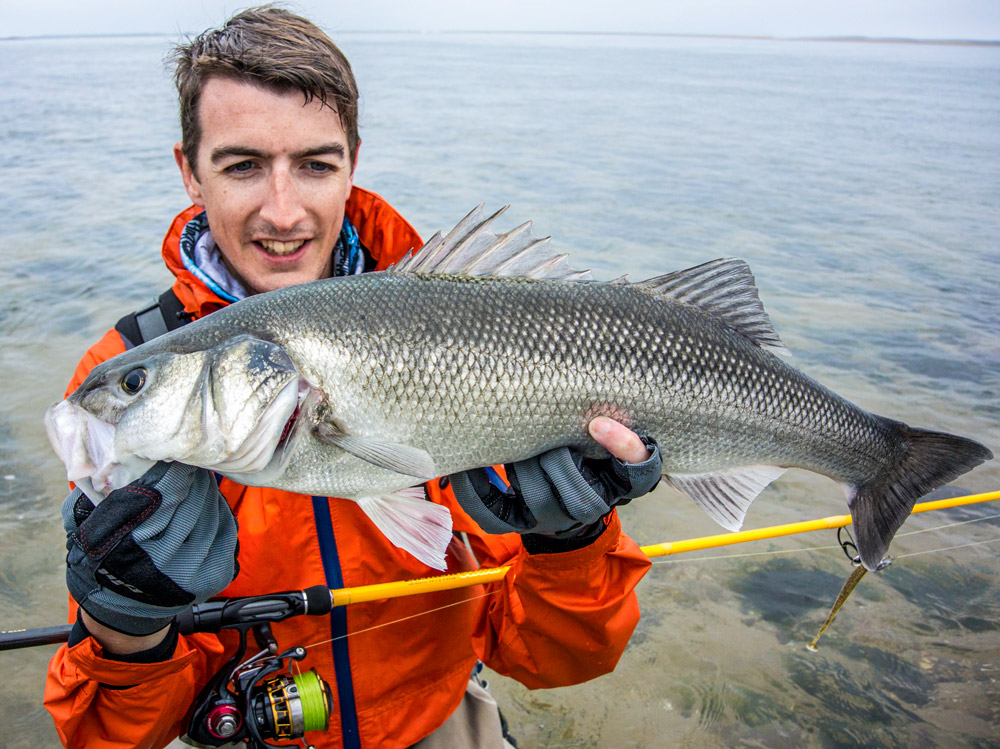
The hardware
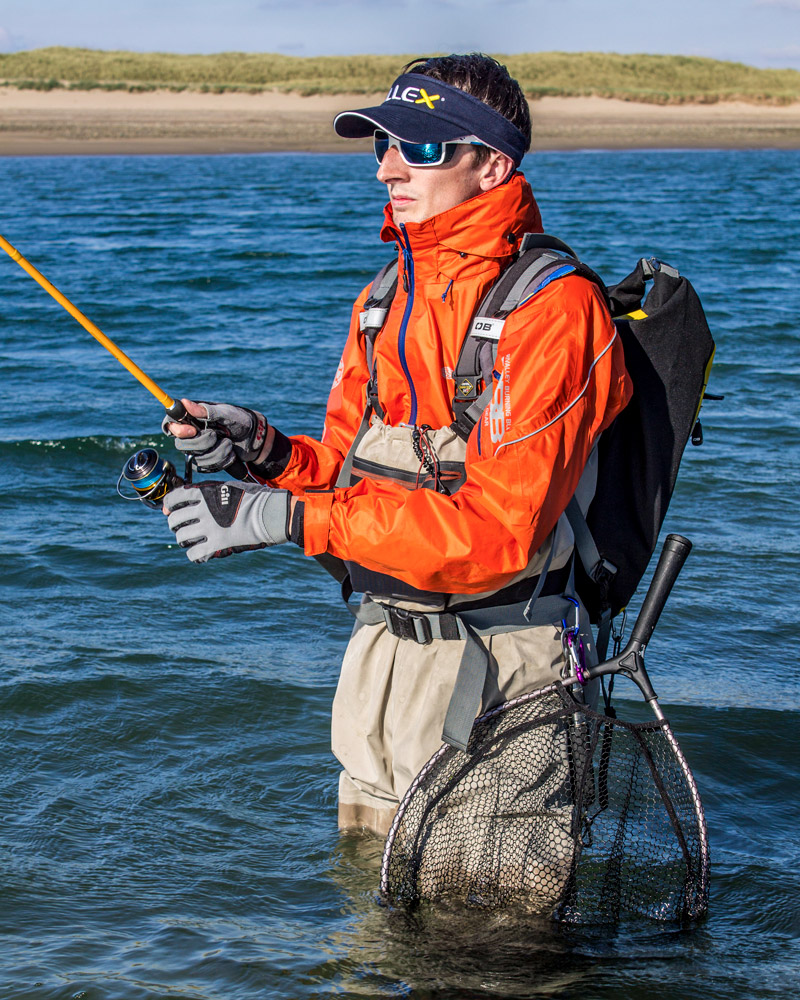
Any standard bass set-up will do the job for this work, however a few things will make the experience a little easier. I prefer long lure rods around 8’6″ to 9’6″ which allow me to keep the line up and away from the water to prevent any unnecessary drag from the surface. I currently use an Illex S 260 ML, 5-25g which is sensitive enough to feel every little bump and movement of the lure but has loads of power to play and subdue big fish in the turmoil. As the key to this technique is all about feeling the lure, it is crucial to use a highly sensitive, low diameter braid – 8 strand braids are ideal for this and there are plenty of brands to choose from, such as Sunline, Varivas, YGK, the list goes on. Fluorocarbon leaders are also essential – I prefer to use as long a leader as possible as it theoretically reduces the chances of the fish being spooked by the braided main line and therefore resulting in a more natural presentation. The FG or GT knot will allow you to fish longer leaders without them catching in the tip eye – it is basically the smallest knot you can use to join braid to mono or fluorocarbon and it retains pretty much 100% knot strength. You can get some useful videos online which will help you tie this knot. If you want something a little faster and less complicated then a simple reverse Albright will be fine. I use a Daiwa 3000 Certate but any small fixed spool will do the job as line capacity isn’t really an issue in this scenario. All you need is a reel which will withstand abuse from salt water and has a smooth drag.
The technique
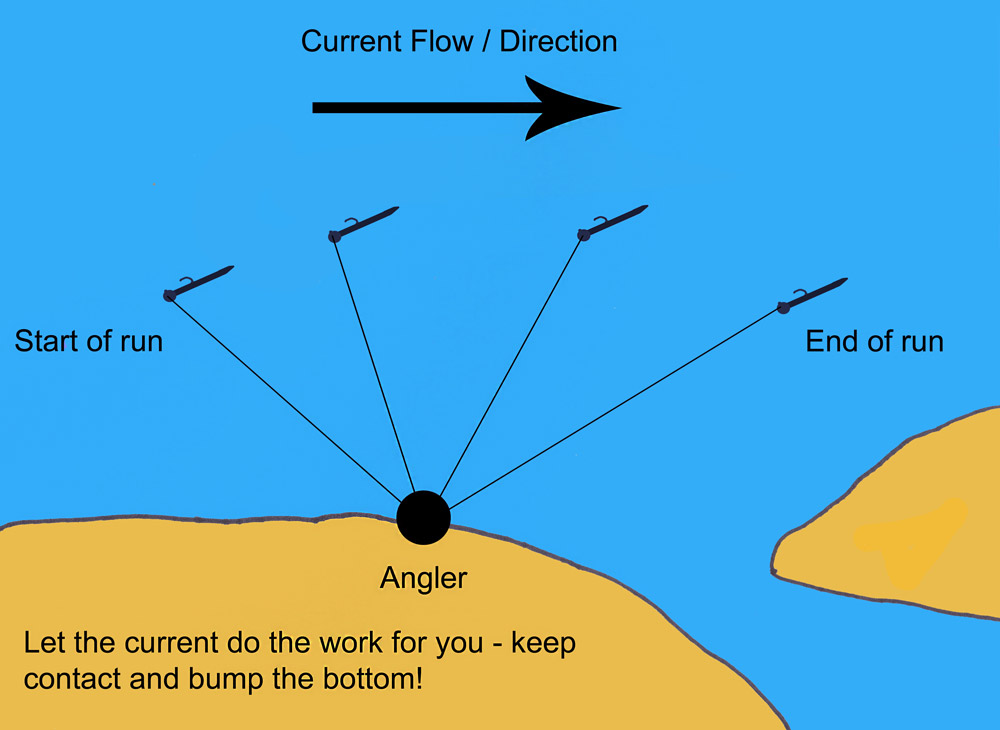
In short, I have found the best way of presenting a lure in estuaries is using weighted soft plastics, cast upstream, trundled down the current and waiting for the fish to nail them. The object is to use the existing flow to carry and present the lure to the fish. The key is to match the weight of the jig head to the current speed in order to deliver the most natural and realistic lure presentation. Trout fly anglers approach streams in a similar way using a technique called Czech nymphing, so in many respects this shares the same base principles.
Once you have read the water and determined the direction and strength of current, you then need to make a cast upstream. Give the lure a short time to sink, close the bail arm and pick up the slack gaining contact with the lure. You may find that the lure will bump naturally along the bottom and you have little to do. However, a slow retrieve will help keep things tight and in tune.
In some cases it may be necessary to mend any line which is floating on the surface film but this will largely depend on the buoyancy of the braid. Some braids sink but the ones which float can increase drag and effect contact with the lure. Try lifting the rod up high, which in turn will raise the braid up from the water. This is why I prefer to use rods over 8’6″, to avoid these scenarios.
When the lure reaches the end of the run simply twitch or hop the lure back towards you – in theory it looks a little unnatural as the lure will be swimming against the direction of flow but if worked slowly enough, it will still trigger a reaction from a hungry bass. The first few runs will all be trial and error. You may be lucky enough to select the correct weight of jig first time but often it will take a few tweaks and changes to find the size which suits the conditions. Of course the weight will need to be changed as the flow increases and decreases, depending on tide state.
Choosing the correct weight
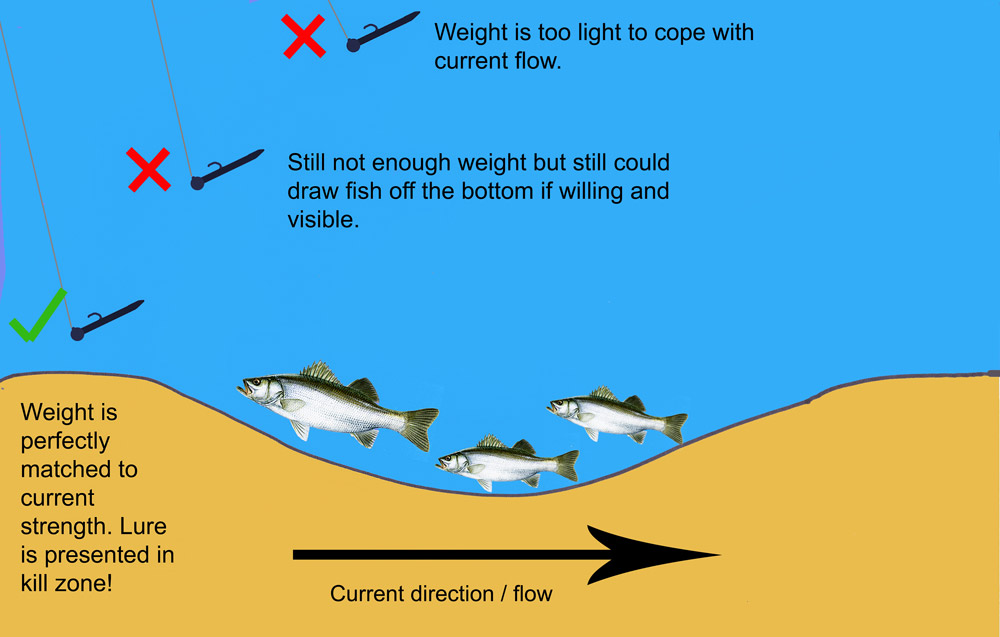
Many people associate weight with casting distance but in this case it is all about matching it to the current speed. Too heavy will result in the lure sitting static on the bottom. Too light and the lure will fail to cut through the rip and wash past in the upper layers of the water away from the targeted zone. Once you figure out the correct weight, you should start to feel it bump along the bottom at a nice steady pace. Now your lure will be in the taking zone.
I usually carry a selection of jig heads from 5g up to 20g and this will usually cover most scenarios unless you experience some serious rips in which case you may need to go above 20g and beef up the kit to match. To add a little extra action to the lure as it swings, lift the rod up with a short twitch. Be sure not to be too erratic or you will draw the lure high off the bottom and out of the kill zone.
In order to cover as much water as possible you will want to make casts at varying distances, creating different runs for the lure. Think back to when you scouted out the mark. Where are the features? Were there any defining points where two currents met or a back eddy was formed? These are all ideal places to present the lure.
Don’t feel the need to cast as far as you can unless a defined structure dictates the need to. It will surprise people how close bass will hug the shoreline. If you think about it, you often see sandeels (a favourite food of bass) shoal close to shore, therefore it makes sense that the bass will pursue.
Jig head profile
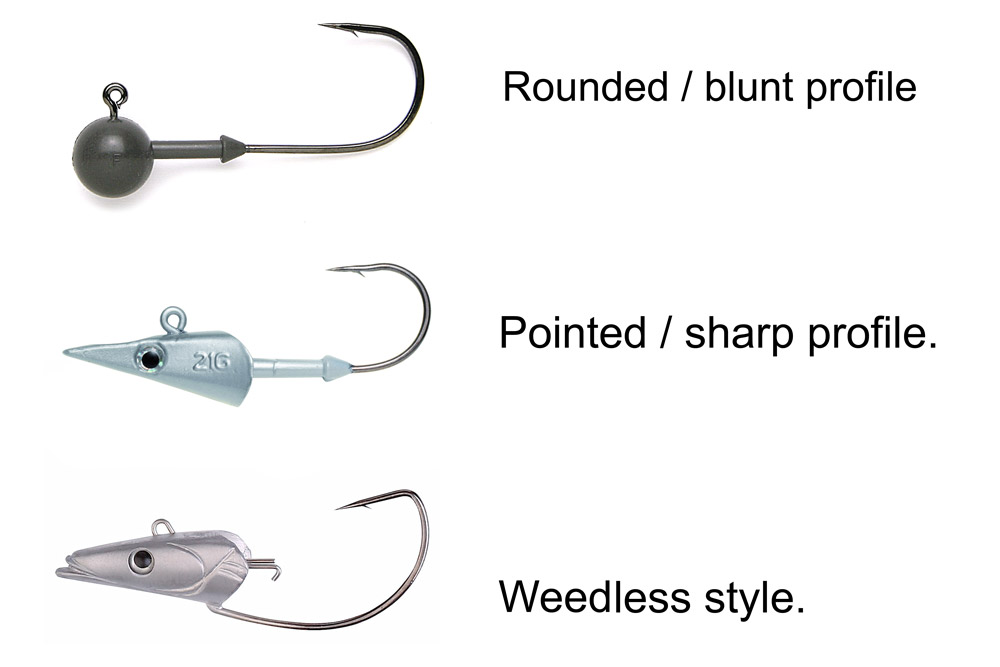
Not only is the weight of the jig head important but the profile will play a large role in the presentation. Jig heads come in various shapes and for this style of fishing you will want ones with a round or blunt profile. These will be more inclined to bump and trundle along the bottom compared to a dart or pointed head which is more likely to dig into the bottom and cause unwanted resistance.
Lure choices
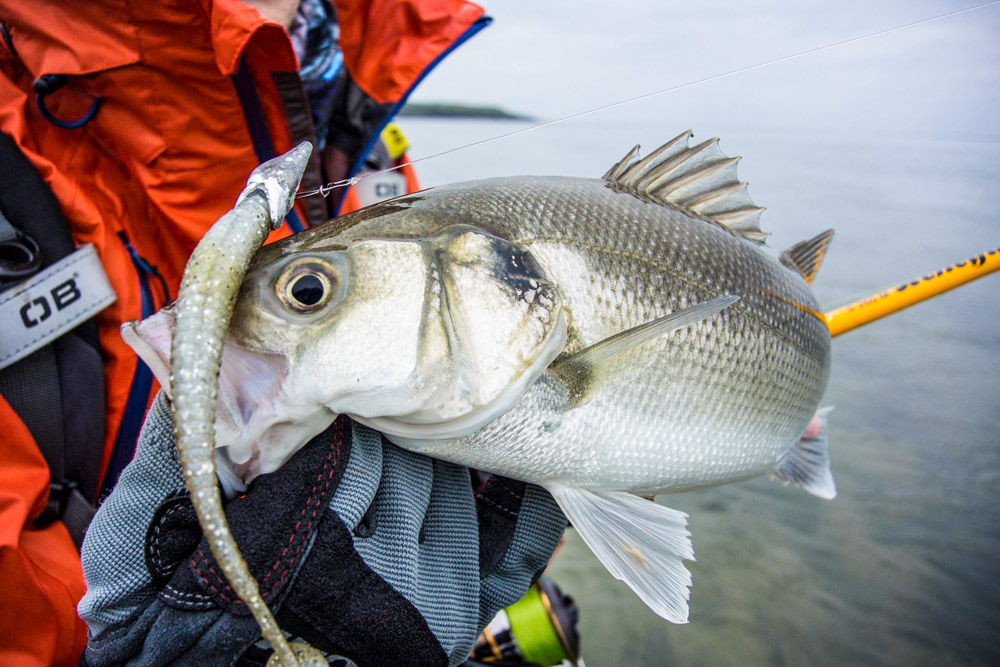
Once you have found moving water the next task is selecting a lure which can be presented in a natural manner to the fish. Presentation is key in these scenarios. Before choosing a lure, think about what the bass may be feeding on. Maybe they are chasing shoals of sandeels or perhaps hunting juvenile mullet? This will have an impact on both the profile and colour of your lure. Sandeel imitations will tend to be more slender in shape and can vary in size from 4 – 6 inches. Browns, olives and greens often work well with flashes of silver. Mullet or baitfish style lures will often have a paddle tail which works well in current. These lures usually have a two-tone effect with a dark back and a lighter under-belly.
“Before choosing a lure, think about what the bass may be feeding on”
On a recent trip I caught over 90% of my fish on the Illex 4.8″ I Shad Tail in Pumpkin Gold Silver and Wakasagi colours – these, in my opinion, are one of the deadliest lures for imitation sand eels in a current. The profile is slim and the small paddle tail adds a bit of extra vibration and presence to the lure without compromising the slim, eel-like profile. I fished these on a range of jig heads from 16-21g which suited my scenario perfectly depending on the tide state and changing current speeds. In fairness, although I have a huge amount of confidence in this lure (which I think is half the battle when it comes to any kind of fishing) all your usual sandeel imitations will work – Megabass X Layer, Lunker City Sluggo, Fiiish Crazy Sand Eel and so on.

Trial and error
Some bays and estuaries can seem vast and unmanageable at first but don’t be put off. Break them down into smaller areas and marks. Be methodical in your approach and start applying some of the principles outlined above. Never be discouraged to go and explore, walking the shoreline or scouting areas at low tide to see what structure or features are revealed. Time spent exploring is never time wasted. Sadly, there is no substitute for putting in the rod hours and gaining experience on the water. Every time I go out, I am constantly learning and discovering new tactics and approaches. Searching and exploring these estuaries and back bays will open up new fishing opportunities and who knows just what lurks in those channels and gullies. That dream double figure fish may just be lying in wait!
Last season my father caught a fish of a lifetime – a superb bass of over 11lb from an estuary-style scenario and again this year we have already seen some nice fish between 7-9lb tempted on soft plastics presented in the current. Off the rocks on the open coast these big bars of silver put up some scrap but in fast flowing current… well, words can’t really describe how hard they can pull back. It’s just awesome on well-balanced lure tackle!
Steven Neely
