
One last cast…
Renowned guide Roger Baker gives an insight into fishing Ireland’s premier specimen sea trout fishery, Lough Currane
Issue 1 (Jan-Feb 2015) Roger Baker


Chris Wathen is a regular guest at our lodge. He has fished with me on Lough Currane every summer for the past 12 years. He likes good fishing and he likes good food so Chris knows both the boat and house routines well. He looks at his watch and tells me we should be thinking about getting back for dinner. I nod in agreement but all my five senses are working on fishing including, possibly, a sixth sense. “One last cast”, I reply. The sounds of those three words resonate in my head like a hollow promise. One last cast, then another last cast… followed by another last cast, then another and another. Presently, a second reminder comes from Chris who knows that the dinner wife don’t take no prisoners unless there is good reason. I concede, “okay…”, and start putting the fly line back on the reel, but halfway through winding it on to the drum the voice inside whispers quietly, “one last cast”. The short line unrolls and the team of three flies hits the water while simultaneously the point fly explodes! This was a ‘big fish day’ and this is the explosive end of that big fish…
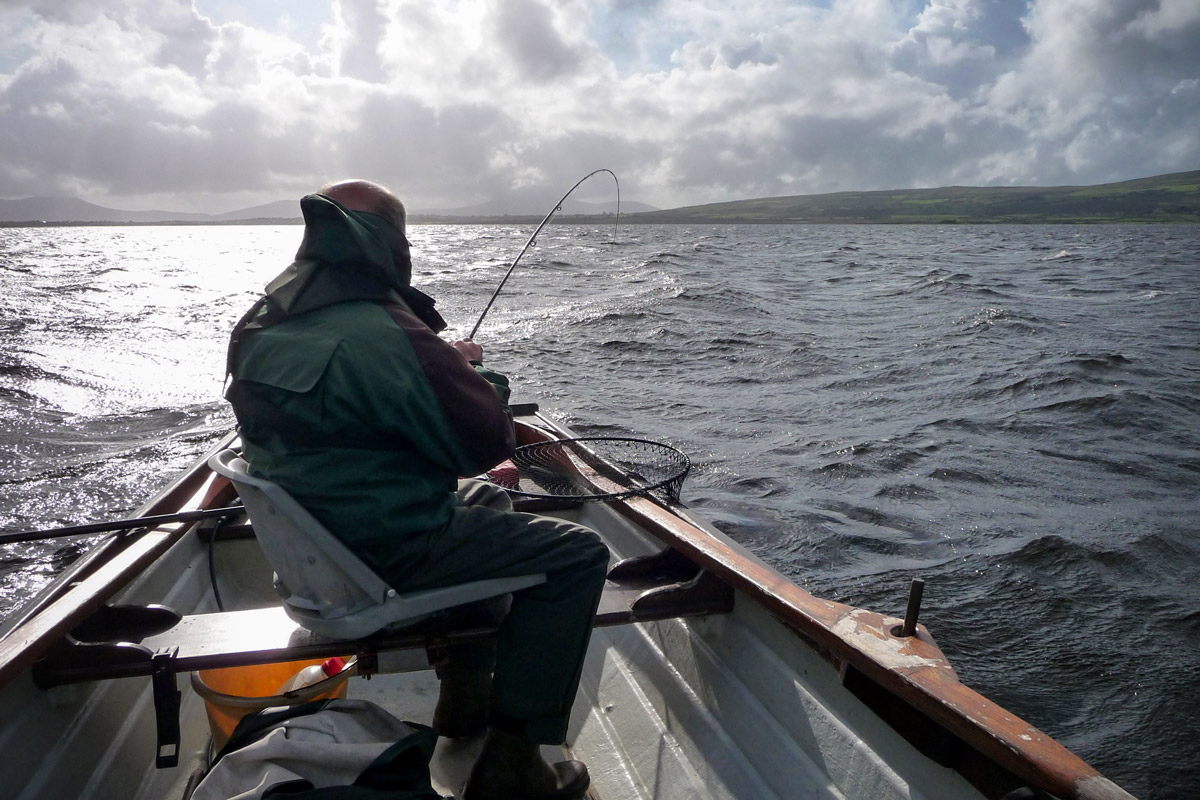
We have been fishing in a big wave and a strong south-westerly is now blowing us across the lough while I am playing a big trout. There is much underwater structure – sedimentary sandstone bedrock – in this part of the lake. Much of it breaks surface as small islands and much more lies hidden beneath the surface as potential hazards, to the experienced or inexperienced, in a big wave. Unlike resident brown trout, which spend their lives in their freshwater habitat, sea-run brown trout, or sea trout as we call them, rarely dive into rocks but swim over them. Most of the fighting goes on near the surface or in the snag-free zone above the rock. Because they live and swim in the coastal tidal vectors, where they eat lavishly on high-protein diets and build strong muscle, they fight harder, pound for pound, than their freshwater brethren. They are, of course, both the same species, Salmo trutta.
A ‘Juner’ is a fish that left the lough in March as a smolt and has returned for the first time weighing around one pound. A shoal of these beautifully silvered fish are the cream of the sport when you can come across them. Even one of these gives a good account of itself on the standard 10 foot, #7wt fly rod and line. This one, ten times that size, is giving a great account of itself. Chris rings home to explain there will be a delay and to put dinner on hold.
The three flies on my cast are 63 inches apart, which is the length that I stretch my arms out when making up the cast with its two droppers and point fly. The fish has taken the Green Peter, a sedge pupa or stonefly pattern, one of the most important in the box. However, it is ten feet and six inches below the top dropper, and if I’m not careful I could wind the top dropper into the tip ring. This happens on occasion, so I always tie my droppers around the mainline in a way that they can break off without the mainline snapping (via a four-turn water knot). But there is no way that I’m going to take that chance with this fish. Normally I could stand up out of my seat and raise the rod higher but this fish is bending the rod double and putting it way out of range of the landing net in a boat bobbing in a big wave. The wind has picked up to a higher speed of 14 or 15 miles per hour and soon, in what seems a very short time, we are possibly a mile from where we hooked up, and now close to Major’s Point on the eastern shore of the lough. I have no alternative but to tell Chris to take the rod and pull hard. At first he refuses, and then sees the futility of gentlemanly fishing morals, and does as I ask. I extend the landing net handle to its limits and dig the net down deep, something I would never do under normal circumstances, and bring the fish safely on board to lay it on the unhooking mat.
After motoring out from the shore a safe distance, I set about the unhooking and freeing the fish from the net. After a few quick photographs I wedge myself against the boat’s gunnel and hold the fish in the water to revive. I hold the wrist of the sea trout’s tail in my right hand while supporting it under the belly with my left. I move the fish gently backwards and forwards in the water to pull oxygen-rich water over her gills. I’ve been doing this revival for about 20 minutes but I do not let her go until she swims off strongly by pulling her tail from my now calculated grip. Do not let them go too soon, else they may just sink to the bottom and not be able to recover. They need your careful assistance, here more than ever, to spawn again, and perhaps to fight another day.

After reading this and you’re a newcomer to lake or lough fishing for sea trout, or even an old hand, you may be wondering why the flies need to be so far apart. Well first, if you use only two flies this isn’t a problem. The third fly makes the first two flies fish better, and as the point fly, that is the Green Peter’s second job. I like the flies far apart so that one is not a distraction to another, and the trout gets to look at them only one at a time. Sea trout are very shy, they’re very easily spooked, they have to be. Another reason that I don’t use connecting floss loops is that they offer too much distraction. I know this because I’ve had sea trout, and brown trout, take them. Instead, I nail-knot a 9ft tapered leader to my fly line at the start of the season, and uni-knot one of those 2mm stainless steel rings to the end. To this I tie the leader, making the whole rig about 20ft long. When the end of the fly line touches down on the water, the long leader presents a lesser distraction for the sea trout to the flies.
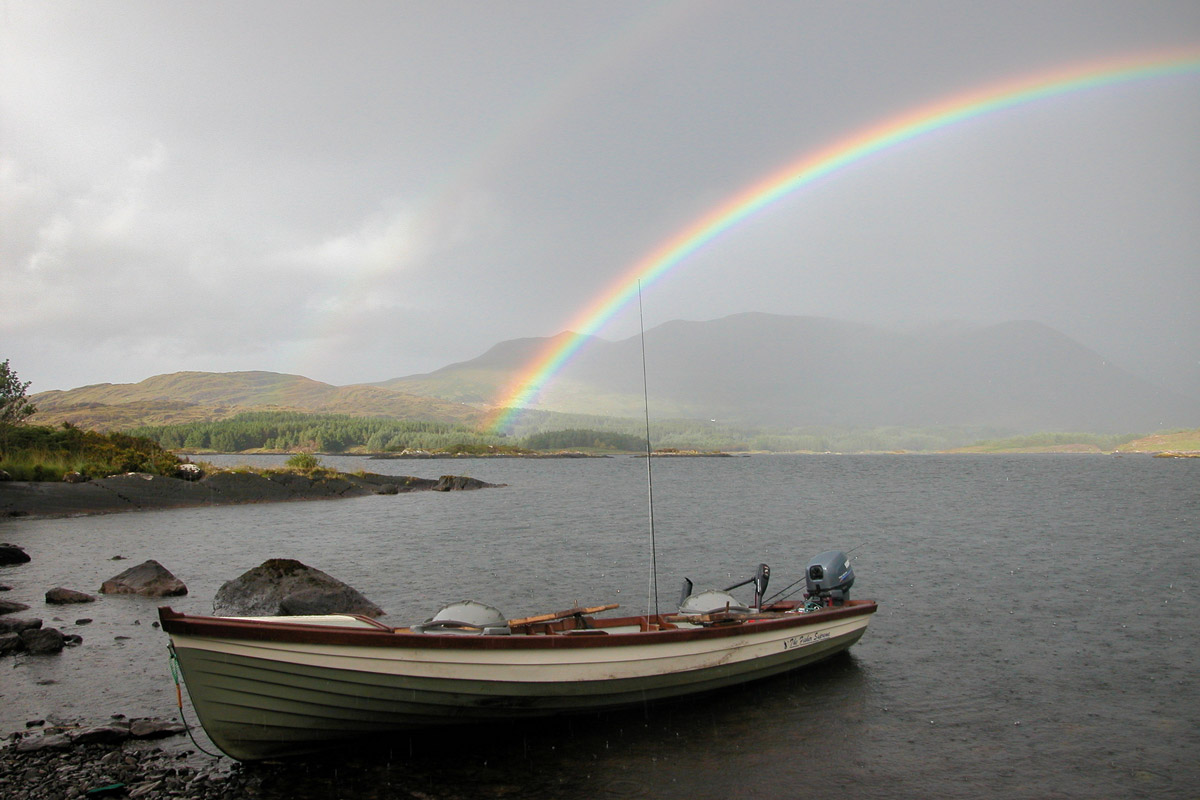
Early season, from middle to the end of March, I most likely go out alone with an intermediate glass line and a single large fly on the point with perhaps one dropper six feet above it. The point fly will be a large fry imitating pattern like a medicine, zonker or snake. Currane is a hard water and I’m very lucky in that I can go more or less whenever I like, all the season through. However, if you fancy a crack at a big sea trout, in the most beautiful silver livery and fresh muscled condition, then April is the month. They’re hard but they’re worth it. After May and June, as the season moves on (always too quickly), the fish get darker and take on the colours of resident brown trout. Personally, I think all trout should be returned from the end of July. The fish in this story was a July fish. Still in great, hard fighting condition but just starting to lose the silver and the pristine magic.
Roger Baker
Roger runs the beautiful Cloghvoola Lodge on the shores of Lough Currane and offers his expertise as a ghillie in both fresh and saltwater in the Waterville area.