
Rodfendr: an Irish angling innovation
Issue 27 (Mar-Apr 2019) Alan O’Shea Off the Scale


Genuine advances in fishing tackle are naturally becoming less common. In many areas of manufacturing, the phrase ‘reinventing the wheel’ springs to mind, very much variations on a well-understood theme. Sometimes, though, an idea comes along that is truly pioneering, a product that, when you see it for the first time, makes you question ‘now, why didn’t I think of that?’. This can certainly be said of the Rodfendr, a new, inventive yet simple concept in rod support and protection.
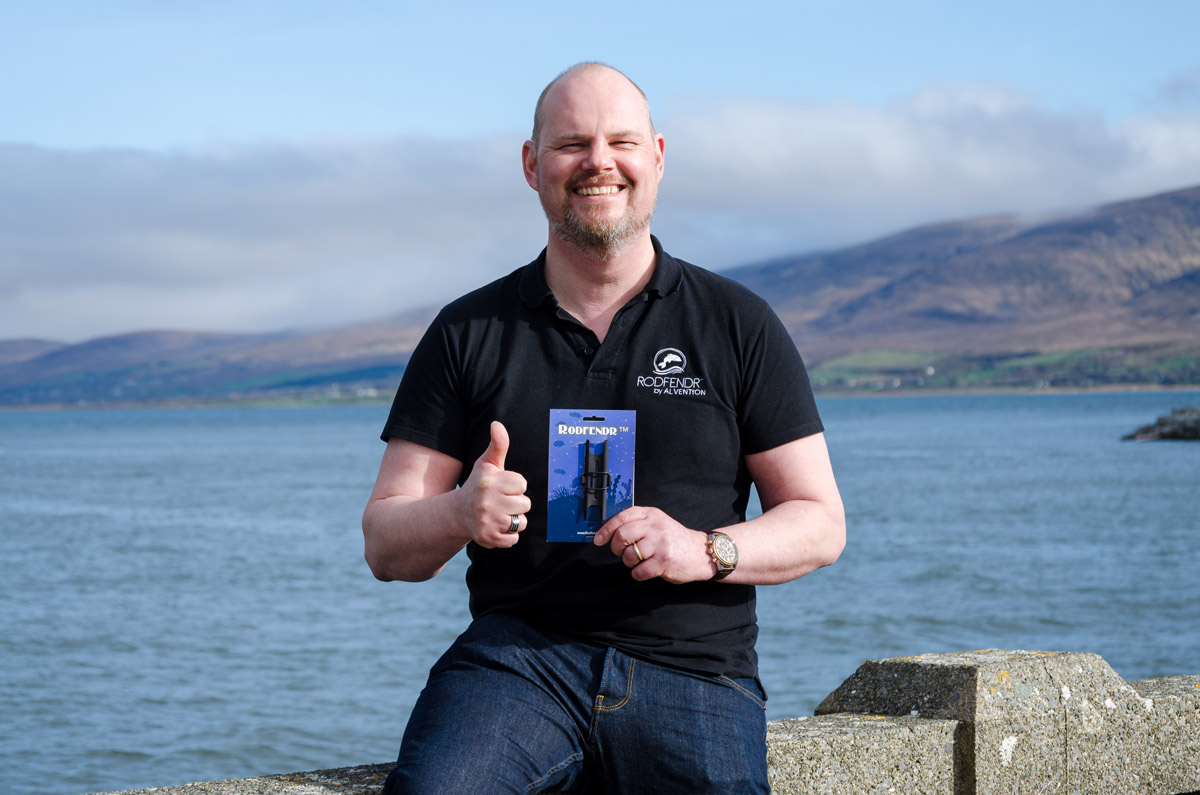
Whilst the majority of us might recognise a design flaw with a certain product, very few are able to translate that into a real-world answer. In truth, many people the world over are happy with makeshift solutions – and that’s fine – but not Alan O’Shea. The Tralee native is the archetypal, modern innovator and owner of the Alvention company. He clearly sees things others don’t and, more importantly, is willing to see those realisations through to the end. His latest creation is a classic example.
Mother of all invention…
Having fished for much of his life from the very popular Fenit Pier, leaning a rod against the walls or railings when waiting for a bite was a no-brainer. Alternatively, a tripod could be used, propped up against the pier itself. Classic shore fishing stuff. “The original idea for an on-the-rod rest”, Alan reflected, “was more to make fishing with my kids less stressful, than anything else! [Laughs] A few years back their attention spans, like many youngsters, weren’t great and I found myself constantly worrying about their rods scraping, scratching and possibly breaking against the pier wall whenever they’d leave them lying around between bites. I’d had my own rods blow over in the wind so many times it was untrue, even on a tripod. There were a few tip snappages… Anyone who’s fished Fenit will know how ‘blowy’ it usually is out there and countless other marks are the same. I just knew there just had to be something I could make that would solve this. Wet bait towels just didn’t cut it – they blew away too!”
“I just knew there just had to be something I could make that would solve this. Wet bait towels just didn’t cut it – they blew away too!”
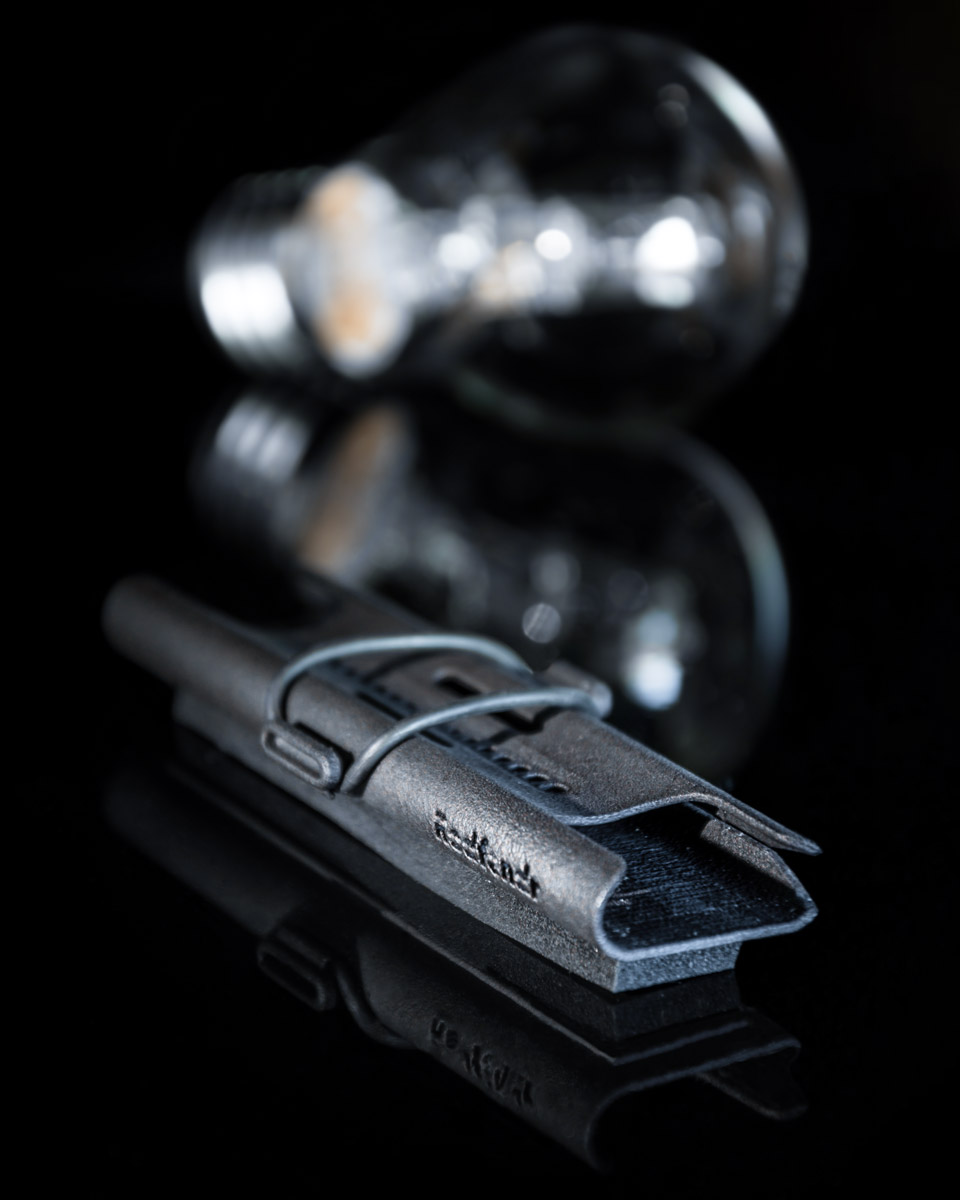
“After some thinking, I realised that a device attached to the rod itself was the way to go. There was nothing out there remotely like this – I looked – but I came up with a very rudimentary solution involving some conduit pipe and rubber”, Alan chuckled. “It worked – sort of! – but not very well. It slipped on the rod, wouldn’t stay in position, wasn’t very line friendly and inhibited casting a lot. Basically, almost all of the things I wanted it to do, it failed at! [Laughs] But it did remove the need for a tripod or cloth and did stop the rod blank getting damaged and sliding about so much. I knew I was onto something.”
The future is 3D
It was in March 2017 that he first came up with the idea that now resembles the finished Rodfendr. “I actually had a €400 3D printer at home at the time and was forever playing about with different designs for various products, mostly for the plumbing industry, which is the family business. Naturally enough I tried my hand at making a rod support with what I had but it left a lot to be desired. I was limited by the materials I had to work with, the cost of it and, of course, my own experience of manufacturing 3D products.”
A chance encounter in early 2017 saw Alan befriend Tralee-based 3D printing company Wazp and it was then that things really gained momentum. “I had formulated a design that I knew would do what I wanted and the team at Wazp allowed that to become a reality. It took a lot of time though, figuring out the various design elements, materials, components. I think we went through nine different versions of the Rodfendr before arriving at the final prototype, in November that year”, he recalled.
“The Rodfendr could be moulded from plastic in China or India, yes, in the normal way, but structurally it would be far, far weaker and just wouldn’t stand up to any sort of abuse”
For the uninitiated, the benefits of 3D printing are huge compared to traditional manufacturing methods. “Obviously, in comparison, the speed of turnaround is rapid with 3D printers”, explained Alan on a typically blustery Fenit pier. “But also, the way the product is made is far stronger than anything that can come out of a mould. The Rodfendr could be moulded from plastic in China or India, yes, in the normal way, but structurally it would be far, far weaker and just wouldn’t stand up to any sort of abuse.“ From the outset, Alan said he wanted to do this properly and using the latest printing technology fitted in with his philosophy perfectly. “3D printers construct an object using layers of resin, which can be cross-laid almost like a mesh, so the final product is incredibly robust.”
Because of how it’s made, the Rodfendr is unbelievably strong for its size and thickness, and, not being made of cheap moulded plastic, it is nowhere near as brittle either. “We’ve made sure to use a special resin that has a very high thermal tolerance, from -50° to +90°C, so it won’t react to extreme cold or heat. Obviously, this will make the product even more durable”, Alan proudly told us.
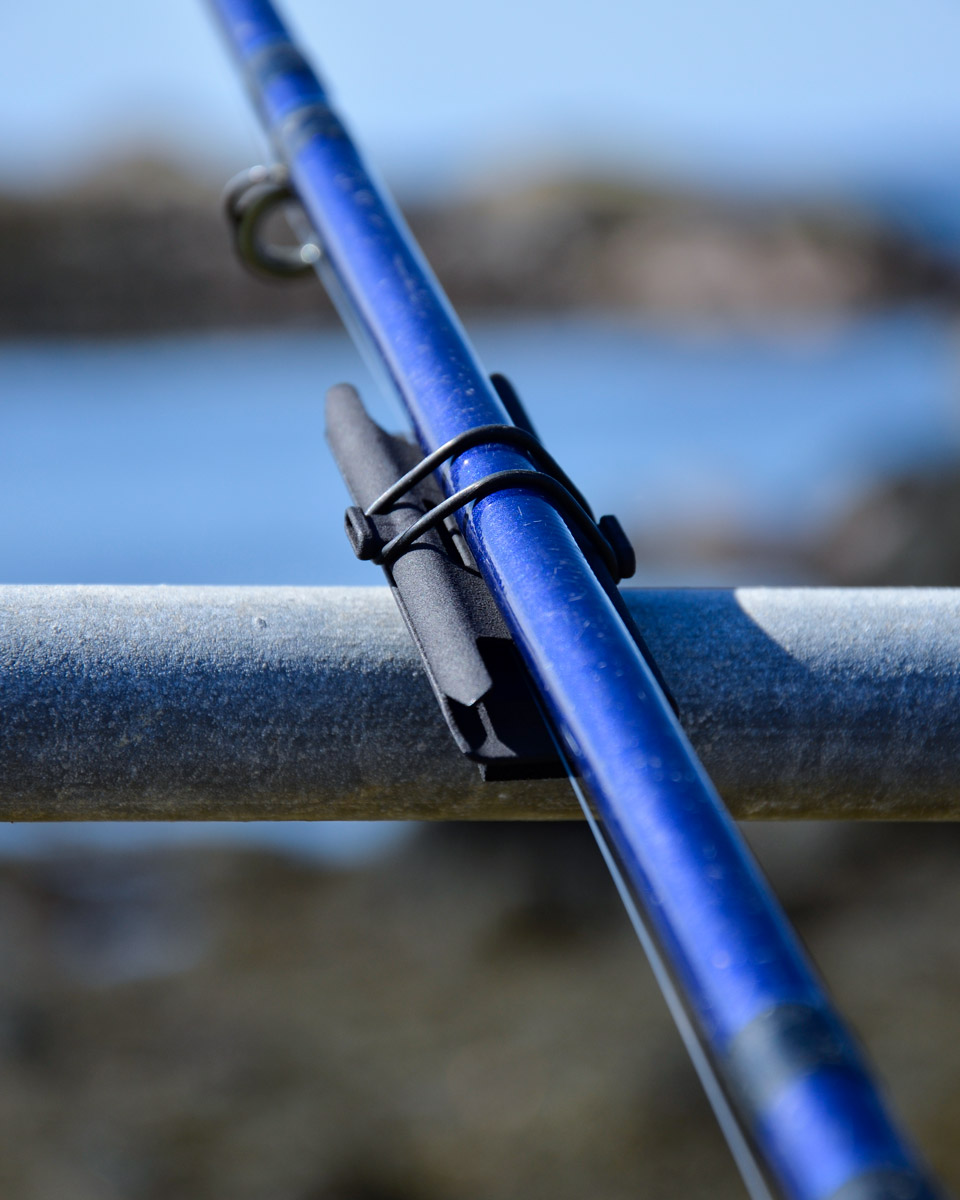
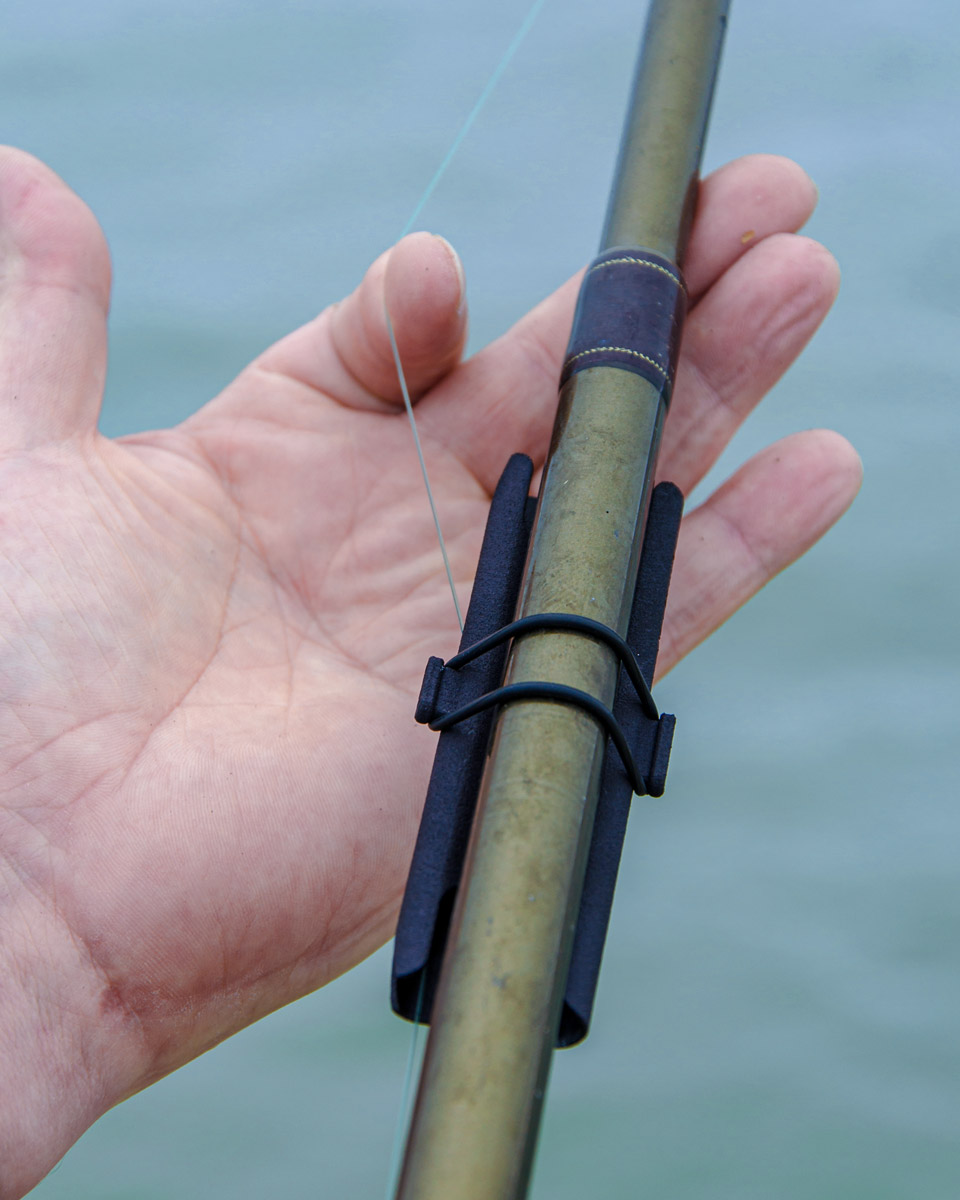
The Rodfendr simply attaches to your rod by way of a weather-resistant rubber band. There is a slit along one side which your mono or braided mainline fits through, allowing it to run freely through the rod rings as normal. It doesn’t hinder bite detection nor does it significantly impede casting. “Yeah, a few customers have been worried about how it might affect casting distance”, assured Alan, “but the Rodfendr is mostly designed for pier and rock mark use, where you’re not usually going to be casting very far anyway. If you are worried about losing a few yards off your cast then all you have to do is simply turn the product to the other side of the rod blank, out of the way of the line, as you are casting out.”
In practice though, even if you keep the line running through the device on the cast, it doesn’t appear to have any real impact at all on short to medium range casting. Of course, if you are paranoid about it for any reason – and you’ve no real reason to be – removing the Rodfendr for casting is simply done by uncoupling the rubber band. It takes literally seconds. For those wondering, the product is super-lightweight, tipping the scales to a mere 9 grams. You will hardly notice it is on your rod at all.
Evolution of an idea
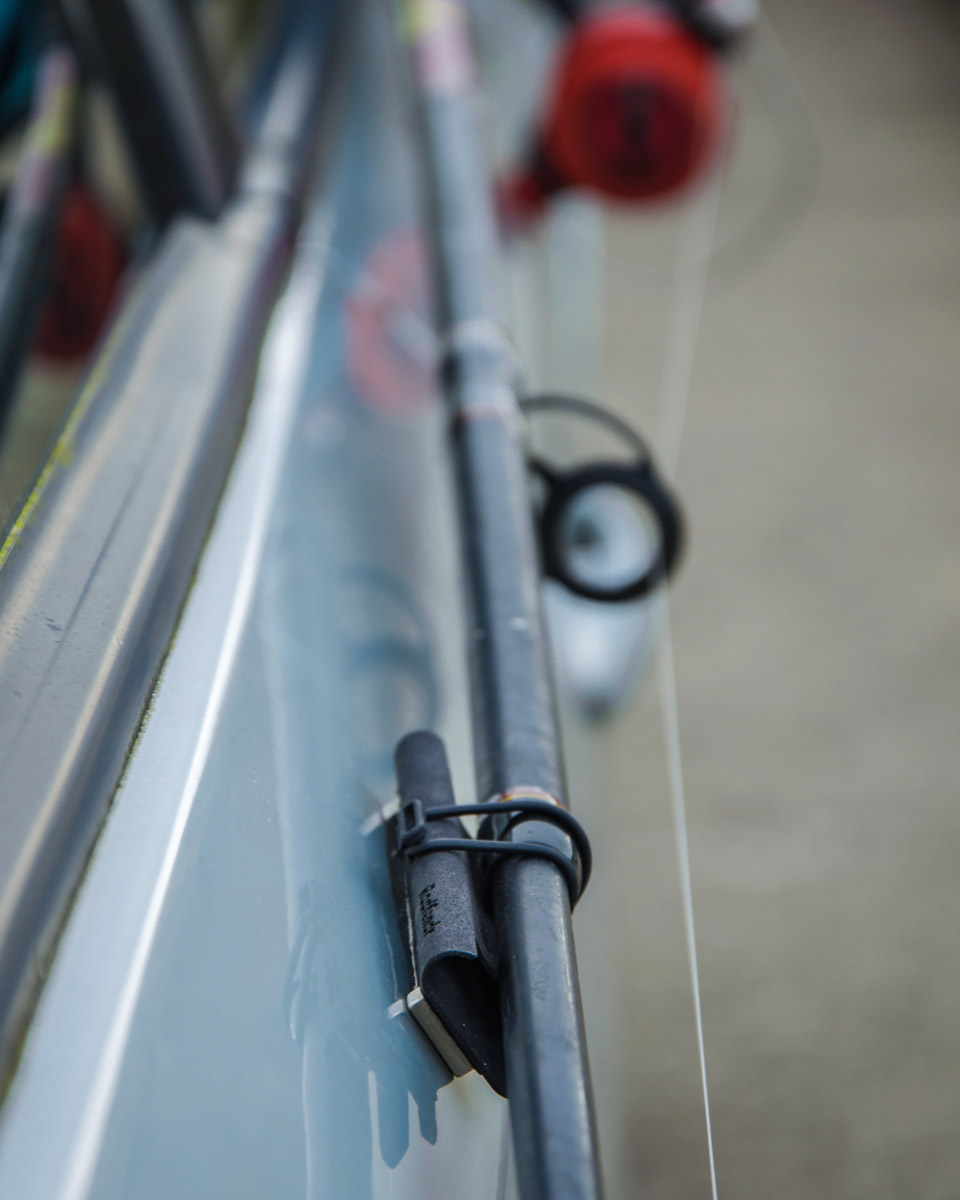
As with any good company, and any good product, Alvention are keen to listen to users and make modifications as necessary to improve the Rodfendr. They recently attended the 2019 Irish Angling Expo in Swords and a lot of the feedback, especially from fly anglers, was to include some sort of magnet so it could also be used to support rods against the side of vehicles, where a lot of anglers tackle up and down. “We listened to what anglers wanted and we made some improvements”, stated Alan. “There are magnetic rod holding devices on the market for fly and lure anglers, little more than a bit of foam with a cheap disc magnet on the underside. We tested all of these and found that they were not very strong at all and often slipped on the surface of a car or van. Some even scratched the paintwork because of this and overall they just don’t offer a proper solution to the problem they are supposed to fix.”
So, the Rodfendr mark II, called the ‘Rodfendr Pro’, is now available, with two incorporated magnets. Alan explained that,“these are rare earth magnets, which are far superior in strength compared to bog-standard ones. This means that, for a slight increase in production cost, once the new Rodfendr attaches to your vehicle it isn’t going anywhere until you take it off. It is more than capable of supporting a full-length rod, horizontally. Because it doesn’t move or slide you’re not going to damage the paintwork either.” This is great example of implementing a simple modification with no impact to functionality.
“We listened to what anglers wanted and we made some improvements… Once the new magnetic Rodfendr attaches to your vehicle it isn’t going anywhere until you take it off”
In the pipeline
So, what does the future hold for Rodfendr? It all seems genuinely positive. “We are a young start-up company with limited resources but, as the word spreads in the angling world, we are getting more and more tackle shops on board all the time, which is fantastic”, beamed Alan. “As time goes on there are more reviews, more users, more feedback – this is vital for us moving forward.” Rodfendr has already progressed to a second version, and soon Alan hopes there will be a third incarnation which allows thinner, lighter rods to use the product as well. “The original design was mainly for heavy shore fishing and boat rods but we see the need for a rod support device for light spinning and fly rods also. Soon we hope to make another very small modification which will allow the Rodfendr to have a more universal fit on any rod, big or small.”
After much paperwork and considerable financial outlay, Rodfendr is currently a patent-pending product, not surprising given its uniqueness in the angling world – there really is nothing else like it out there (hence the patent). Even though he has gone to great lengths to protect his idea, Alan is certainly not adverse to collaborating with larger companies to help get the product to more customers.
Conclusions
So, ultimately, will the Rodfendr catch you more fish or make you a better angler? No. Will it save your rod from avoidable breakages? Quite possibly. Will using one give you some more peace of mind when using your beloved rod? Yes.
This is a useful, innovative product, conceived by anglers, for anglers, designed and produced in Ireland using quality materials that are genuinely built to last. What’s not to like? Alan O’Shea is one of those people who sees things others don’t. A real go-getter, a thinker, a do’er. Hopefully the angling world continues to embrace people like him.
 Rodfendr is available in selected Irish tackle shops now, as well as online here . Price is €14 per device or €17.95 for a double pack. The Rodfendr Pro (magnetic version) is also available on the same website for €12.95.